
Cottage Holiday vs Hotel: Which Is Better for Families?
A family holiday in the UK usually comes down to one decision before any other: do you book a self-catering cottage, or do you book a hotel? Both can give a family a good week away, but they give very different kinds of weeks. A cottage gives you a whole house, a kitchen and a front door of your own. A hotel gives you clean sheets every day, breakfast made for you and someone else to worry about the boiler. The right choice depends on who is travelling, how long you are staying and what your evenings look like, and this guide works through each of those questions in turn so you can decide with confidence rather than guesswork.
There is no single winner, and any guide that tells you one option always beats the other is selling you something. What the evidence does show is a clear pattern: cottages tend to win for longer family stays, hotel rooms tend to win for short breaks, and the deciding factor is often something as simple as what time your children go to bed. If you are new to self-catering, start with our self-catering accommodation guide, which explains what is normally included in a cottage stay and what to bring, and read our guide to how much a UK cottage holiday costs before you compare prices, since the figures in this article are indicative and every price should be verified with the provider.
The Quick Answer: It Depends on Your Family and Your Trip Length
For a family of four staying a week in the UK, a cottage is usually the better choice. You get separate bedrooms, a living room, a kitchen and a garden, and the cost is for the whole house rather than per room, so the price per person falls as the family grows. For a one or two night break, especially in a city or near an airport, a hotel is usually the better choice, because the convenience of arriving to a made bed and a cooked breakfast outweighs the extra space you would barely use.
Trip length is the single most useful rule of thumb. Staying three nights or more tips the balance towards a cottage, because the kitchen, the washing machine and the living room start to pay for themselves, and the family settles into a routine. Staying one or two nights tips it towards a hotel, because you arrive, sleep, eat out and leave, and the cottage chores of shopping, cooking and cleaning eat into a short break. The same logic applies to party size. Two adults and a baby in one hotel room is workable for a weekend. Two adults, three children and a grandparent need either two or three hotel rooms or one cottage, and the cottage is almost always cheaper and calmer.
The trend supports this. Research reported in July 2026 found that nearly half of UK families had taken a trip spanning three or more generations in the past year, and that self-catering properties were outperforming hotels for those groups specifically because they offer the space, kitchens and separate sleeping areas a hotel room cannot. The same research, from the Sykes Staycation Index 2026, found that 64 percent of UK adults planned to take a UK break in 2026, so family groups are a large and growing part of the cottage market, not a niche.
Space and Privacy: One Front Door vs Several Hotel Rooms
Space is where a cottage wins most clearly. A family cottage gives you a living room, a kitchen, separate bedrooms and usually a garden, all behind one front door. The children can play in one room while the adults sit in another. A teenager can close a bedroom door. A toddler can nap in a quiet room while the rest of the family carries on with the day. In a hotel, a family of four usually shares one room, or two rooms down a corridor, and every activity happens in the same space, which means the whole family goes to bed when the youngest child does, and the whole family wakes when the earliest riser does.
Privacy works the same way. In a cottage there are no shared corridors, no neighbours through a thin wall and no need to keep the children quiet in case the room next door complains. A family can eat at ten in the morning, walk in with wet coats, light a fire and let the evening sprawl. In a hotel, the same family is sharing walls, corridors and a breakfast room with strangers, and the outdoor space is usually a bench outside reception. For families with babies or toddlers, that privacy is not a luxury, it is the difference between a holiday and a very expensive week of sitting in the dark.
Large families feel the difference most. Our guide to large and family cottage holidays explains how cottages that sleep ten or twelve give each generation its own room, and why the bedroom, bathroom and living space ratios matter more than the headline sleeps number. A hotel stay for the same group means booking several rooms, hoping they are near each other, and meeting in a public bar or a restaurant rather than a living room of your own. For a multi-generational break, grandparents, parents and children under one roof, the cottage is usually the only option that keeps everyone together without keeping everyone on top of each other.

The Kitchen Question: Eating as a Family Without the Restaurant Bill
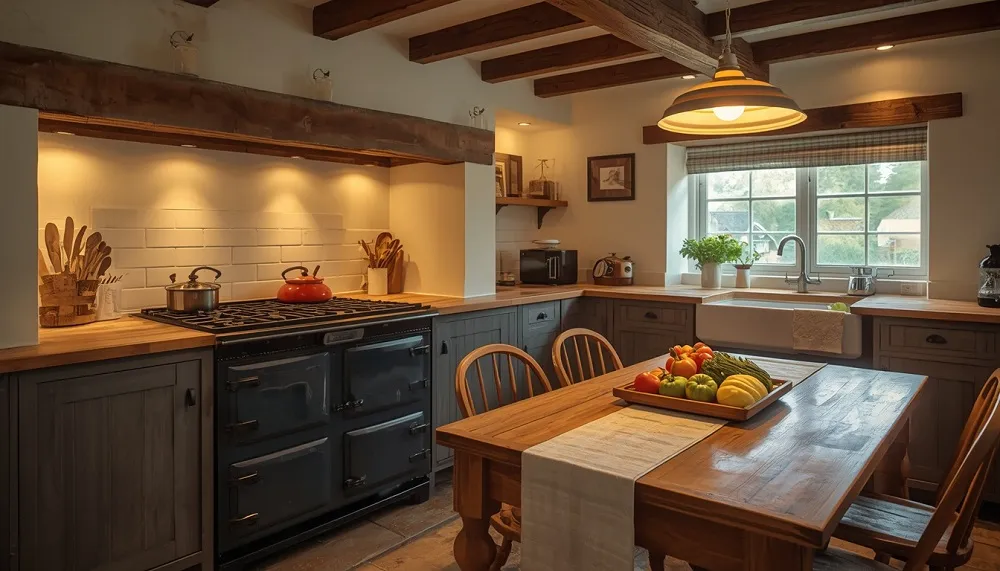
The kitchen is the quiet hero of a family cottage holiday, and it is also where the cost comparison is decided. A cottage kitchen lets you cook a proper dinner, keep milk for morning coffee, pack a flask before a walk and feed a fussy eater exactly what they will eat, at whatever time they are hungry. It also lets you eat together at a table, which is surprisingly hard in a hotel, where the family either eats in a restaurant at set times or eats in shifts on the bed.
The money adds up quickly. Hotel breakfasts commonly add 12 to 18 pounds per person per day, before dinner, and a family dinner in a restaurant can easily cost 40 to 60 pounds, which rapidly loses its appeal over a full week. A self-catering shop for a family of four, by contrast, typically runs to a modest weekly figure if you shop before you travel, and the saving is the difference between a cottage that looks expensive and a hotel that turns out to be expensive. The cottage price is for the building, so the cost per head falls the more people you squeeze in, while a hotel price is usually per room per night, with dinner and drinks added on top.
The kitchen also solves the problems hotels cannot solve: dietary requirements, allergies, weaning babies who need food prepared three times a day, and children who will only eat pasta. None of those are insurmountable in a hotel, but each one costs money or patience, and over a week the cost is real. If your family would eat out every night regardless, the difference narrows, because a good pub dinner twenty minutes away costs much the same whether you sleep in a cottage or a hotel. If you would cook, it does not narrow at all, and the cottage wins by a wide margin.
Bedtimes and Routines: The 7pm Test
Ask one question before you book, and it will settle the cottage versus hotel debate for most families with young children: what happens when your youngest child goes to bed at 7pm? In a hotel room, that is your bedtime too. You sit in the dark, whispering, waiting for the baby to sleep, with the television off and the lights low. In a self-catering cottage, you close the bedroom door and have the rest of the evening, a living room, a glass of something, a book, a conversation at normal volume.
Family travel writers call this the deciding factor, and they are right, because it is the one issue that no hotel upgrade fully solves. A hotel suite with a separate sleeping area helps, and a family room with a partition helps, but a cottage with a proper living room solves it completely. The same logic applies to mornings. A cottage lets the early risers go downstairs and make breakfast without waking the rest of the house. A hotel room lets the early risers wake everyone, or sit on the bed waiting for the breakfast room to open.
Routines matter beyond bedtime too. A baby on a strict feeding and sleep routine, a toddler who needs a nap after lunch, a child with a medical condition that needs regular food or medicine, all of these are easier in a place with a kitchen, a fridge and a room of your own. A washing machine matters as well, because a family of four on a week-long stay generates a pile of laundry that a hotel will wash at hotel prices, while a cottage washes it for the price of a tablet. If your family runs on routines, the cottage is not just nicer, it is the practical choice.
Cost Compared: A Worked Example for a Family of Four
The only honest way to compare a cottage and a hotel is to compare the whole week for the whole family, not the nightly rate on the listing. A cottage advertised at 120 pounds a night can undercut a 95 pound hotel room once you factor in what each one charges on top, and a cottage that looks dear can turn out to be the cheaper option once breakfasts, dinners, parking and laundry are counted. The example below is illustrative only, not a quoted price, so verify real prices with the provider before you budget.
Take a family of four, two adults and two children, staying seven nights in the UK outside the school holidays. An indicative cottage for the week might cost 1,400 pounds, which is 200 pounds per night for the whole house, or 50 pounds per person per night, and that includes the kitchen, the living room and the garden. Two hotel rooms for the same family, even at a modest 110 pounds per room per night, cost 220 pounds per night, or 55 pounds per person per night, before any food. Add breakfast at 12 to 18 pounds per person per day and the hotel adds 48 to 72 pounds a day for the family, or 336 to 504 pounds over the week, before a single dinner. Add parking, which city hotels often charge at 15 to 25 pounds a day, and the gap widens further.
Short breaks are the trap in the other direction. Many cottages set a three-night minimum with a Friday or Monday changeover, so a two-night weekend can cost close to three nights, and a large supermarket shop, logs for the burner, a cleaning fee and the restaurant meals that creep back in when nobody fancies cooking can narrow the gap fast. For a two-night stay, the hotel often wins on total cost as well as convenience, because there is no minimum stay, no cleaning fee and no big shop. The lesson is to price the whole trip, not the headline rate, and to count the meals. Our guide to the best time to book a UK cottage holiday covers lead times, the cheapest months to travel and the short-break rules that often catch families out.

Babies, Toddlers and Teenagers: Who Wins at Each Age
The best answer changes as your children grow, so it is worth matching the accommodation to the age of the youngest child. With a newborn, up to about four months, self-catering wins clearly, because the baby sleeps in a travel cot in a separate room, bottles can be made at 3am without waking anyone or calling reception, and the family keeps its own schedule. With a baby at weaning stage, five to twelve months, self-catering wins strongly, because food needs preparing three times a day and a kitchen is an operational necessity rather than a luxury.
With toddlers, the cottage wins on space and safety. A toddler needs floor space to crawl and pull up to stand, a garden to play in, and a stair gate at the top and bottom of the stairs, none of which a standard hotel room provides. Check the garden the way you check the beds, and read our dog-friendly cottage guide for enclosed garden checks, since the same fence, gate and gap questions apply for a toddler as for a dog. With school-age children, the cottage still usually wins, because the children get a bedroom of their own, a garden or games room to play in, and a kitchen table for homework or holiday projects.
Teenagers are the one age where a hotel can catch up. A teenager wants Wi-Fi, a town to walk around, and a bedroom door that closes, and a hotel in a lively town can offer all three. A cottage in a remote village can feel isolating to a teenager, however beautiful the view. If you are travelling with teenagers, choose the cottage base as carefully as the cottage itself, and look for a village or market town with a shop, a cafe and something to do on foot, rather than a cottage at the end of a long lane. Our Cotswold villages guide shows how to pick a base by traveller type, and the same test works in any region.
Dogs, Laundry and Luggage: The Practical Stuff
Practical details decide more family holidays than anyone admits, and cottages win most of them. Dogs are welcome far more often in cottages than in hotels, and a cottage with an enclosed garden lets the dog out without a lead, a lift and a lobby. A hotel that accepts dogs usually charges a fee, restricts the dog to certain floors and expects the dog never to be left alone in the room, which is a poor fit for a family that wants to go to dinner. If you are bringing a dog, read our dog-friendly cottage holidays guide before you book, which covers enclosed gardens, pet fees and the rules that catch people out.
Laundry is the second practical win. A family of four on a week-long stay needs a washing machine, and a cottage has one. A hotel will do your laundry at hotel prices, or not at all, which means packing for the whole week rather than half of it. Luggage is the third. A cottage has a hallway, a boot room or a utility room for coats, boots and beach kit, and a car parked at the door. A hotel has a wardrobe and a corridor, and a family arriving with a pushchair, a travel cot and four suitcases will feel the difference within an hour of arrival.
Hotels win the practical argument in one place: help when something goes wrong. A hotel has a reception desk, someone to fix a broken shower at eleven at night, and a spare room if the plumbing fails. A cottage has an owner or an agency on the phone, and the response may be a plumber tomorrow rather than a porter tonight. Check the cottage emergency contact before you book, and ask what happens if the heating fails or the hot water stops, since a family with small children cannot wait a day for a repair. If the cottage has a hot tub, read our cottage with a hot tub guide for the rules, hygiene checks and child safety questions to ask before arrival.
When a Hotel Is the Better Choice
A cottage is not always the right answer, and it is worth naming the cases where a hotel wins clearly. A one or two night break, a city break, a family wedding trip or a night near an airport is almost always better in a hotel, because the stay is too short for the cottage to pay off and the hotel removes every chore. Families who hate cooking should also choose a hotel, because a cottage holiday that means cooking three meals a day for a week is not a holiday for the cook, however much the rest of the family enjoys it.
A hotel also wins when the family wants to be looked after rather than to look after itself. If the thought of preparing three meals a day on holiday fills you with exhaustion, a hotel removes that entirely, and for a 48-hour city break that trade-off is entirely worth it. Hotels are also the better choice when someone in the party has limited mobility and needs a lift, a level entrance and help on call, since many cottages are converted barns and farmhouses with steep stairs and uneven floors. Check the access details of any cottage before you book, and choose a hotel if the cottage cannot answer the access questions clearly.
There is also a middle option worth knowing about. Apart-hotels and serviced apartments give you a kitchen and a separate sleeping area plus daily cleaning and a reception desk, which is precisely the combination many families want. The trade-off is cost, since apart-hotels typically charge more per night than a standard cottage, but for a city break of three or four nights the premium is frequently worth it. If your family trip is a city stay rather than a countryside stay, an apart-hotel may be the best answer of all, and it is worth pricing before you decide.
How to Choose: A Quick Decision Checklist
Use this checklist when you shortlist, and the answer usually becomes obvious. First, how many nights are you staying? One or two nights points to a hotel, three or more points to a cottage. Second, how many people are travelling? Four or fewer in one room is workable in a hotel, five or more usually needs a cottage or several rooms. Third, what time do the children go to bed, and do you want an evening after that? If the answer is yes, you need a separate living room, which means a cottage or a suite.
Fourth, who is cooking? If nobody wants to cook, book a hotel. If someone enjoys cooking, or the family has dietary needs, book a cottage. Fifth, is a dog coming? If yes, a cottage with an enclosed garden is almost always the better choice. Sixth, what is the total cost, not the nightly rate? Price the cottage week against the hotel rooms plus breakfasts, dinners, parking and laundry, and compare like with like. Seventh, where are you going? A countryside or coastal break suits a cottage, a city break suits a hotel or an apart-hotel. If you are planning a romantic break for two rather than a family trip, read our romantic cottage breaks guide, since couples face a different version of the same choice.
Finally, check the practical details of whichever option you choose. For a cottage, confirm the bed layout room by room, the garden fencing, the minimum stay and changeover day, what is included and what is charged on top, and the emergency contact. For a hotel, confirm whether the family can have adjoining or connecting rooms, whether a cot or extra bed is included in the price, and whether breakfast is included or charged per person per day. Either way, book early for school holidays, since the best family cottages and the best family rooms go first, and confirm the cancellation terms before you pay.
Is a cottage holiday cheaper than a hotel for a family?
Usually yes for a week-long stay, because the cottage price is for the whole house and the family cooks some of its own meals, while a hotel charges per room per night plus breakfasts and dinners. For a one or two night stay the hotel is often cheaper overall, because cottages have minimum stays and cleaning fees. Always price the whole trip, including food and parking, and verify prices with the provider.
Is a hotel or a cottage better with a baby?
A cottage is usually better with a baby, especially for stays of three nights or more. The baby sleeps in a separate room, so the parents keep their evening, and the kitchen lets you prepare bottles and weaning food at any hour. A hotel works well for one or two nights, particularly if you do not want to cook, but the 7pm bedtime problem is hard to escape in a single room.
Can a family of five stay in one hotel room?
Rarely, and only in a family room or suite designed for five, which is uncommon and expensive. Most hotels cap a standard room at four guests, so a family of five usually needs two rooms or a suite. A cottage that sleeps five or six is a simpler and usually cheaper answer, since the price is for the house rather than per room.
Do cottages or hotels suit dogs better?
Cottages suit dogs far better. Many cottages welcome dogs and have enclosed gardens, while hotels that accept dogs often charge a fee, restrict the dog to certain floors and do not allow the dog to be left alone in the room. Always confirm the dog policy in writing before you book, including how many dogs are allowed and what the fee is.
What should a family check before booking a cottage?
Confirm the bed layout room by room, including sofa beds, the number of bathrooms, whether the garden is fully enclosed, the minimum stay and changeover day, what is included such as linen, towels and logs, and what is charged on top, such as cleaning and pet fees. Also confirm the emergency contact and the cancellation terms before you pay.
The honest answer to the cottage versus hotel question is that families usually need a cottage for a week and a hotel for a weekend, and the families who are happiest are the ones who chose on that basis rather than on the nightly rate alone. A cottage gives a family space, a kitchen, a garden and an evening after bedtime. A hotel gives a family service, convenience and a break from chores. Work out how long you are staying, who is coming, what time the children sleep and who is cooking, and the right choice will be clear. Whichever you choose, price the whole trip before you book, confirm the details in writing, and book early for the school holidays, because the best family stays in the UK go first.


